Showing posts sorted by date for query spinoza. Sort by relevance Show all posts

Wednesday, April 23, 2025

Descartes' Dream

 Oh joy! I bought this book over three decades ago and read it briefly when I purchased the thing. There are reasons that I was attracted to the book. As well, anyone who took some semblance of a western civilization course would have run into Descartes. Then, of course, mathematicians know of the man. 


And, in terms of residue and remainings, philosophers have the guy entirely wrong. That has been my opinion for decades. But, was I right? Well, all of this time, there was nothing to make me think otherwise. 

That is, until I reread the book during the past few weeks. And, that reading was at a desk marking the book as a student might while venturing off to the reference material, especially in regard to the history of mathematics. And so, now being through the book and wishing to build a case for both Descartes and Vico (PJ Davis and his co-author use this guy as a foil very well) there will be a series of posts. 
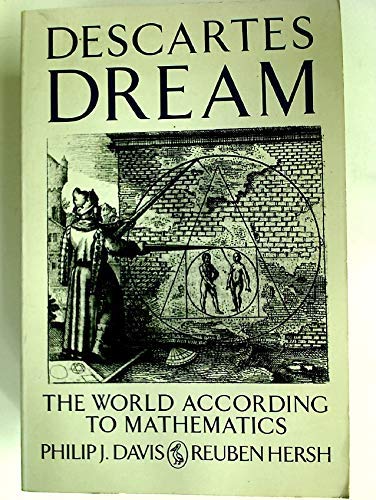
First though, the joy mentioned above. Here is the book, courtesy of Google. As these posts unfold, I will be referencing this Google offering and marking up selected images from the book. The exposition will not follow the Contents but will bounce around by theme.  
  • Descartes' Dream - PJ Davis, R Hersh, 1986 -- Page forward, please, and look at the Contents. My interest is the loss of meaning that we see now with GenAI on the landscape muddying the waters as well as consuming unreasonable amounts of resources, such as energy. 
I must add two more links before going further as this will be split into many posts with sidetracks. 
  • Goodreads - I like this site but do not want an account nor do I use Apple (did in the beginning - but I am a developer believing in open methods) or Amazon (never spent time on the site; probably am the oldest person alive who never bought Amazon, do not intend to). So, this post is a 10 for the book (100?) out of 5 ;>). 
  • Cambridge - This is obligatory as most of the brainy who came here as colonists were of that ilk and not of Oxford. That's an issue that we can look at in detail given the subject of these posts. So, their post is about the dreams of Descartes that people want to hear about.  
Okay, the motivation. 
  • Truth engineering - This link is to my collection of posts and articles that deal with subject of interest to discussions on intelligence, AI, machine learning and such from several levels due to my roles. I am a mathematical economist who worked in the role of engineering support. And, in particular, it was a long time effort at supporting advanced computational systems which included numeric modes (say, like Nvidia is pushing), knowledge based engineering (which would tame machine learning - and did back in the day), and general expert systems where I was immersed in Lisp via the machines and systems built upon them plus doing all of this in the context of real work (taming numerics, geometrically) that had measurable and highly effective rewards.  
  • Immanuel Kant (1704- 1804) - Now, of course, Kant came later but did overlap the life of Vico. We will look at that. For a few years now, I have been arguing that Kant was overlooked. His Prolegomena and Logic (some posts will do a review of this work with respect to its significance) are very much apropos to what we need to think about. Hint: Kant was superb in representing an insight that bridged the dynamics with which PJ&R deal; as such, and given his time, his conclusions can be taken as universal; that is, of course, with parallels being discussed with respect to time (+/- one generation) and space (oh yes, the world as we can now see it given the lenses possible with computational assists - some have been explored); we will entertain others and weigh in on non-euclidean nonsense. 
  • Dreams - This phenomenon has significances that are known widely yet are scoffed at by the mindset described in this book with respect to its long evolution. Okay? 
There are other motivations that will be marked as such as the discussion unfolds. Simultaneously with these posts, there will be summaries on Linkedin and Quora. More detail will be provided as we get the first of these links in place 

---

PJ&R (henceforth, the reference to the book) start off with the dreams in order to grab attention. It got mine, but I was disappointed as I can lay out tales much deeper than they allow. Having said that, I know the PJ is a first-rate mathematician (Harvard guy - his Math Genealogy profile). He proved that time and again in this work. One of his popular ones from earlier times dealt with explaining the mathematical experience. 

And, in this book, PJ&R do a very good job of grounding examples (see end of this post - vagus) upon experience which includes thinking as well as the practical aspects brought by the likes of Brouwer with intuitionistic, constructistic ways.  

But, let's look at the two key guys starting with a disclosure: I will for the most part provide the birth and death year for people referenced. See Kant above. Also, given my situation as of the U.S. and researcher for the Thomas Gardner Society, Inc. which deals with the colony of Massachusetts and its role in the birth and growth of the U.S., I will related things across the waters to activities here (U.S.). 

Example, of late, we are dealing with Bosworth and its relationship to our studies. That is when the Tudor reign started which ended with Elizabeth (Origins and motivations) who was several generations after Bosworth. However, the colonies, 100 years after Henry VIII, created an offshoot of the Ancient & Honorble Artillery Company of Massachusetts. Henry's group and this New England group still exist and are affiliated. There are many more parallels to explore (heard of CS Peirce or JW Gibbs of thermodynamics fame; there are many more). 
  • RenĂ© Descartes (1596-1650) - We all know of him through his work. As a young man, I liked it when I ran into his "Methods" thinking. But, I had a geometric bent anyway and ended up dealing with modeling (on the digital twin side of things) with regard to the guts of the matter (not being an engineer; but this was more fun than the dismal stuff of economics; besides most engineers would not venture into the realms that I saw; which, btw way as a message to to GenAI/LLM folks, is very much pertinent to pulling you guys out of the holes that you dug for yourselves and us). Cartesian space? Yeap, listen up, non-euclidean might be fun; but, bringing in Plato and Vico, we will address that with a modern take, okay?). 
  • Giambattista Vico (1668-1744) - He had several influences but had a focus on humans and their lot and ways. As such, PJ&R were right in using him as the foil to discuss ins and outs of the Descartesian issues. We look forward to bringing in Baruch Spinoza (1632-1677) who was slightly older than Vico. 
PJ&R gave their work a subtitle: The World According to Mathematics. An image of both gentleman is provided in the Preface. Then, the first section, chapters deal with the dreams, their aftermath, and then some comments on the historical contexts that bring Descartes' ideas into scope. As one reads this material, references to computing would be before 1986 which actually is a good thing. 

Of late, many of the older people have been reminiscing about their experiences. As with any human activity, there was lots of activity with unlimited dreams and unbounded motivations. Yet, those years had glorious results some of which deals with the underpinnings of modern computing. Let's point to a couple of examples from Sperry Univac who was #2 to IBM, but there were more companies (say, those of Cray who did one of the first supercomputers): Adventures in Truth  Engineering; Women behind Eniac. There are more examples, but these two set the tone that our use of recent events (as historical analogs) is based upon real experiences (and would be loved by Kant). 

The second section of PJ&R's book? The Social Tyranny of Numbers. Wow, that is so apropos to the current situation. Remember, 1986 was when I was hotly involved with lots of knowledge systems in many different domains. Eventually, that focus reduced to digital product development (of major physical systems which had requirements of precision and meeting stringent constraints). 

My first reaction on seeing GenAI/LLM two-plus years ago was that we could use knowledge modeling to remove some of the issues. However, the other side of the coin was that the "omni" drive of training which came from the motivations that were not mature created a mess. And, crap built into a system cannot be removed (think GIGO, modernized). Quality is built into a product through a quality focus throughout the processes involved. Six sigma is an example but has problems, too. 
 
PJ&R's book addresses these. We will bring out their arguments and tune them to the current situation. This post is an introduction and overview. Some post will be more top-down for obvious reasons. We will have posts that are technically tuned. How deep we go depends upon several things? But, "deep" is relative. Flip it and one has a broadened shallow piece of work. 

-----

But, here is an imperative (thank Kant). After twenty years of assessing truth and its issues from many angles which are touched upon in this blog and others, we concluded that, with respect to cognition which is what I had as a focus, a very proper frame would be at the level of theorectical chemistry. And, along that line, people offer the best of frameworks for study. And, then we can get into the knowledge universe of medicine and much more. Albeit, right now, ponder your vagus system which is depicted with this graphic. 


For all of us, this system drives our life. Yet, we went eons without the types of insight into the dynamics. So, one set of positions were set by those associated with Descartes versus those of the Vico persuasion. And, mathematics? Does not like psychology? Well, this system tells us a lot, including possible motivations across eons, again, ending up with the likes of Jung and more. Gosh, we have to end this but will have common themes such as this one. 

Last word? "Grounding?? So popular to certain philsophers and electricians? We will demonstrate that this provides a grounding which robotics can only dream of. And, cognitive processes residing solely upon heated circuits throwing out buckets of bits? Come on. 

---

Afterword. Did diving deeply into the work change my mind? Nope. Harvard is amiss, several ways. The mathematics of destruction was honed in that environment. But then, lots of cultures were at fault. 

This book getting more attenion might be the salvation of Harvard (one of my interests). Perhaps, we are talking more of a "redemption" which is long overdue. 

--

Follow our series as we expand concurrently along the themes of meaning in the senses of man/machine and of being: Taming GenAI/LLM.

Remarks: Modified: 04/25/2025

04/25/2025 -- Added link for PJD's profile at Math Genealogy. 


Sunday, December 23, 2012

Summary, 2012

This blog got its start in July of 2007, right before its sister blog (7'oops7). As of today, there have been 183 posts with 16 categories. The most read of the Categories relate to the later theme of Finance as game, with T-issues being a close second.
Past 30 days                                    All time
The image shows the most read for the Past 30 days and for All time.

  • Of late (Past 30 days) - Baruch refers to Spinoza who has some revelance in today's world. See the reference to work at Stanford in the post. 
  • Since the beginning (All time) - Leverage and truth II is a fairly early post (March 2008). Remember what was going on then? We seem to be forgetting the lessons as politics forces us into short-term gaming. 
The early years were the most active: 2007 (33), 2008 (46), 2009 (43). Later, there were other blogs which took time away from the first two. Of late, these are the counts 2010 (15), 2011 (24), 2012 (21). 

The blog is expected to become more active, given the development in markets of more computation which raises up the need for truth engineering.  


Remarks:

12/23/2012 --  

Modified: 12/23/2012

Thursday, November 29, 2012

Baruch

Context: See Tru'eng anew, focus going forward, mathematics.

--

Or, later known as Benedict. Spinoza, of course.

Why is he important? As we see neuroscience trying to explain ourselves to us, we can learn from all of the debates over the many years. And, Baruch had a lot to say that is worth considering. His time, by the way, parallels the first entry on this side of the pond that led to the US (to wit, real founders).

I recently saw a reference to a 2003 book on FB which sent me back to my youth (Henry and George) due to its theme being related to Baruch's thoughts. Antonio Damasio, the author, uses our friend (see Stanford's summary of Spinoza's on the physical world) as the basis for arguing the importance of emotions to our cognitive workings. And, that leads right to truth engineering and to the issues related to computation (we'll get there).

---

Aside: Emotions? Well, we have a lot to discuss there. Let's just say that these are involved with mechanisms (operational sense, okay? in terms, too, of the neuropeptidergic'al consciousness (is that all there is?)) that cannot be mechanized (which computation is, folk). What, even with biologically based computers?

Aside: We saw a similar view in the last IJCAI (International Joint Conference on Artificial Intelligence) arguing that biased minds make better inferences (see video on Homo heuristicus). You have to realize that this might seem quite intuitive, yet reasoning (as in applied logics of several sorts) does receive most attention. The Zen awaits further definition.

Aside: That the mathematical framework, so perniciously overlaying ourselves, is right at the core of the current financial mess (still being unwound, folks). A big problem remains with respect to ensuring payments (by that, insure is not in any way meant to imply the gaming by the likes of AIG - or even some pieces of Buffet's organizations - many of the strategies involved stink to high heaven) in the future.

---

We've danced around some necessary points by categorizing them as t-issues and punting them down the road (isn't this what we've done with the national debt?). It might be interesting to re-look at the topic with Baruch's glasses (as in, truth and the senses).

Now, some might complain that thoughts from 400 years ago are not of interest. These arguments have been timelessly debated, not converging, apparently, to anything that would build consensus. As well, the modern world has been very much rewarding of the operational stances. Namely, these are those that do not care with the net effect of turmoils, trampling of the spirit, and much more as a guaranteed fact of life. Perhaps, this might be true for some.

For me, it's nice to run across thoughtful recognition of the musing of earlier thinkers in the context of the up-to-date work that, essentially, is spiraling us toward knowing more and more about less and less in this age of specialization. Too, to have a balanced view like Baruch's brought forward can have several effects; one of these would be an improved overarching worldview. How? We'll get to that.

Finally, a Baruch thought, via SEoP: For measure, both of spatial extent and temporal duration, is a mere aid to the imagination, and not a means of intellectually understanding.

Remarks:

07/09/2013 -- Was there a time when father knew, whether all or most of the time? Many sons railed against that, GEK III, for instance. Some sons had absent fathers, who were no more than some ideal without any material substance. Some sons even followed their fathers. All sorts of positions along an axis. However, there is something new, now. An insidious overlay is threatening us; its origins come from advances in prowess that are less understood than those who practice think is so. Have we left serfdom to a feudal lord behind in order to be wrapped in a more dense veil? The key notion is quasi-empicisism and its being ignored.

01/22/2013 -- T-issues will migrate to issues of science and religion.

Modified: 01/06/2015

Wednesday, August 17, 2011

Henry and George

Foreword: George (see below) has been quoted as saying that the world would be better without editors. I can see his point. They change structure thereby stomping on what an author is trying to convey. Yet, their 'lifting' of the message (assuming that this is possible) can improve what was written. And, would we not acknowledge that some of what we see in blogs could use an edit or two? The whole tone in this blog is supposed to be coherent and, hopefully, convergent to some notion that has extreme importance (in my opinion) to our future. From time to time, there may be what seems like a digression, yet such has a purpose. This is a start of one of those.

---

George is for George Edward Kimball, III whom I met 46 years ago (Aug '65) in Lawrence, KS. In brief, George was my roommate for about six months. He and I kicked around Lawrence until I left in spring of 1967 for SF. I did not see George, again, until 2009 when we (my wife and I) caught up with him at lunch in Lawrence.

As I recall, George and I never talked about our past or families. I read some (especially the recap sponsored by the Irish Times) on George a few years ago. I had not known that his father was close by and was an officer (after high school, I had spent two years in the Army) or that he had a pedigree (his existential being was 'beat' or some semblance).

About two years ago, I started to do my wife's family history (my folks are post-Civil War) and discovered that she was Kimball by several threads. So, was it George or Kimball that I knew (to be explained, in time)?

---

After some reflection the past few weeks, I thought that I would try to understand and to express George's impact on my life and on his times. Plenty have acknowledged his influence. Who is even looking at the larger picture?

---

In another forum, I started a series dedicated to GEK III: Salem Commoners and Cambridge non-commoners. Those posts deal with the times and troubles that we all share in general; these posts here will be more of a personal, and philosophical, nature.

---

Why under truth engineering? George, in a sense, was a collection of axioms and rules within my cognitive framework that express the 'truth.' Are we all not such types of aggregations (in our being?), or as some might say, conglomerations? I used 'archetype' [09/23/2015 -- georgekimball [dot] com is gone] in a prior medium (JMS comments). But, we'll get more into that through time and posts.

While George and I were rooming, I had a revelation about why I bounced around colleges. I wrote an op-ed titled Why I am a College dropout which was published in fall 1965 by the KU paper (I'll post this on-line sometime). Harking back to the editor comment of George, when I re-read this paper recently, I was struck by how far off the mark it was due to editorial changes. Too, I thought that I might redo it in order to clarify the message.

So, not only did I write the article, I dropped classes and became a part-time student for several years at various places. You see, the message in the paper is that the educational experience is targeted to 'career' and employment rather than self-realization (what is that?).

---

Of course, a pragmatic sense would take the more direct thrust. But, I ask you, where will people find some place where they can learn of truth, life, and values that are beyond money and mere posturing?

---

So, who is Henry and why is he first? Well, Henry is for Henry Adams who was quite prolific. He may not have been perfect (and has had his critics), however I really liked his EOHA, for several reasons, when I read it as a young man enough to adopt 'EOJ' (Education of John) for my quest as an autodidact.

Henry's life and experiences were very much different than mine in many ways; yet, given the American experience, there were overlaps. And, that will be a major part of the story as I recall George's roles.

---

In a sense, George was the first cohort that I met who was not hung up in the trappings that are thrown down for the younger set in order to pull them into the established 'order' ostensibly for the sake of peace and harmony. How he might have maneuvered himself away from this might bear some attention. But, that will be later.

Until I met George, I hung my ropes on the tranquility offered by the likes of Emerson (Ralph W., of course) and Spinoza (Baruch, of course). That is not, in itself, bad; yet, post-George the world loomed larger. Let me explain some operational details since there was a diversion into existentialism which, thankfully for me, morphed into a hybrid (with influence by Kierkegaard).

---

Of course, I had sat in classrooms. I had done that in several other universities prior to my sojourn at KU. I even knew many remarkable minds, including a cohort who had been 'indoctrinated' (this will be addressed many times -- sufficient to become clear, it is my hope) at the Sorbonne. Too, I had had my exposure to the counterculture and similar.

Yet, George brought something to the table that I had not seen before. What that was (is) will take some time to explain and discuss.

---

For one, George's posturing was more tongue-in-cheek than earnest. At least, that was my take. In other words, George was the real deal.

Consider please, George's writing reflected his humor from what I have seen (even the early Beat work (it is phenomenal that someone inter-generational, like George was, could be so successful in the medium) and perhaps more).

Too, George knew that 'posturing' is the oldest profession (related to establishing the pecking order); yet, he also did not have to step into the ring, so to speak (I don't think that he knew that I had six brothers -- three of whom are Marines).

---

Mind you, it was at the time of the 'dropout' article that I took to serious self-study (all of the connotations). In my opinion, there is no support in our culture for this type of learning. Nor, is it even respected. Probably, the closest thing would be the book club that has actual discussions.

Are there things like a chemistry club? Physics club? Etc. Oh, I know, lab experience is the main issue here. But, have you heard of a Math club? Oh yes. For students. What about the larger population?

---

As an aside, education has been as bounded (hounded) by 'special interest' groups as has politics.

---

It was while George was my roommate that I started to seriously read Psychology/Psychiatry. In particular, I studied almost the sum total of Jung's works. Too, I began a more experimental set of studies whose results are yet to be published.

Universities are great since their libraries can be a gold mine of material. That is, before the WWW, library stacks were the place to find knowledge. Unless, one sat at someone's feet; I never did this; did George?

Prior to George's advent into the scene, my main learning technique was to wander the stacks, pick books at random, open them to a random page and then start to read. Of course, you would then follow up. It is not unlike going to those things referenced in a text book and actually reading the source material.

Who does that in this day and age?

---

George added to my reading list in an interesting way. Would it ever have come about in my random fashion? Of course, this touches upon the role, and necessity or not, of any mentor during one's journey through the various valleys of knowledge.

---

George was quite social; I met a whole bunch of people while he was my roommate. As well, suffered the sleepless night.

My roommate after George was a student working on his dissertation who was up all night reading and typing notes.

There were several juxtapositions, such as this, that associate in my mind when thinking about George.

---

Henry Adams was about 100 years before George's and my time, and Henry lived through a transitional time. We all know about the transitions that we peers of George have gone through. Ought we be taking a closer look?

I probably ought to find someone from the prior transition times (that is, colonial - late 1600s -- and revolutionary -- late 1700s) in order to complete the proper composite. With both George's and my wife's tree, I'm sure that I can do this (by the way, Adams is a cousin, to boot).

---

The point of all this? Look at what the label says.

Remarks:

08/03/2015 -- George as inspiration of computing and existentialism.

04/23/2015 -- George at Beats in Kansas.

07/03/2014 -- The Magna Charta is a wonderful example for us to apply to provider (king)/user (baron) issues.

11/30/2012 -- Turns out that Baruch will be of more use than I had thought.

07/06/2012 -- Today, we have the one-year remembrance of George Edward Kimball III (GEK III). In another context, there was mention of a wider realm. That theme will be explored within the framework of t-issues in the sense of what we can learn from cohorts. ...

06/17/2012 -- George, again. By the way, the above-mentioned article written while young was influenced by my infatuation with Spinoza. When I think back, I appreciated his 'ethics' focus (may I ask? in the modern world of the best and brightest, who even considers ethics?). One theme of the article dealt with the purpose of knowledge (and acquisition, thereof). Yes, again, the modern view: to increase one's advantage at gaming (idiotic at its core). So, why learn other than to keep your 'lord' (it over all) position? I will try to explain, in due time. It's one of the main themes of the GEK III posts.

12/09/2011 -- Nitty gritty truth I.

12/06/2011 -- Alex Belth characterizes George as a 'bad ass' while adding the further qualification of his being so in the Sportswriting world. I would offer an alternative view that would stress positive connotations. George represented a lot that ought to be more prevalent in a sustainable world. He was iconoclastic and liked to tweak the noses of those in authority. However, he was for the little person and supported their interests. How to describe this better? Hmmm. Would it have a sub-title: When men grow up?

12/05/2011 -- What would George have thought of the OWS?

09/21/2011 -- On Wealth and the CEO MVP.

09/10/11 -- The Georges can get mixed up. We have GEK III, of course. But, we ought not to forget George Orwell who tells me that I dropped out from point collecting, not education.

08/17/2011 -- On cousins, it goes this way. There were early families, say early 1600s. Then, starting around 1630, a mass influx happened in New England. Thousands of families, swamping resources. After about 30 years (we can pick the events in England that relate to this), the flow over here slowed to a trickle. Hence, families over here inter-married so as to make an American line, so to speak. There are many people now from New England who have literally 100s of colonial families in their tree. Hence, one can find 'cousins' everywhere, almost.

Modified: 09/23/2015